


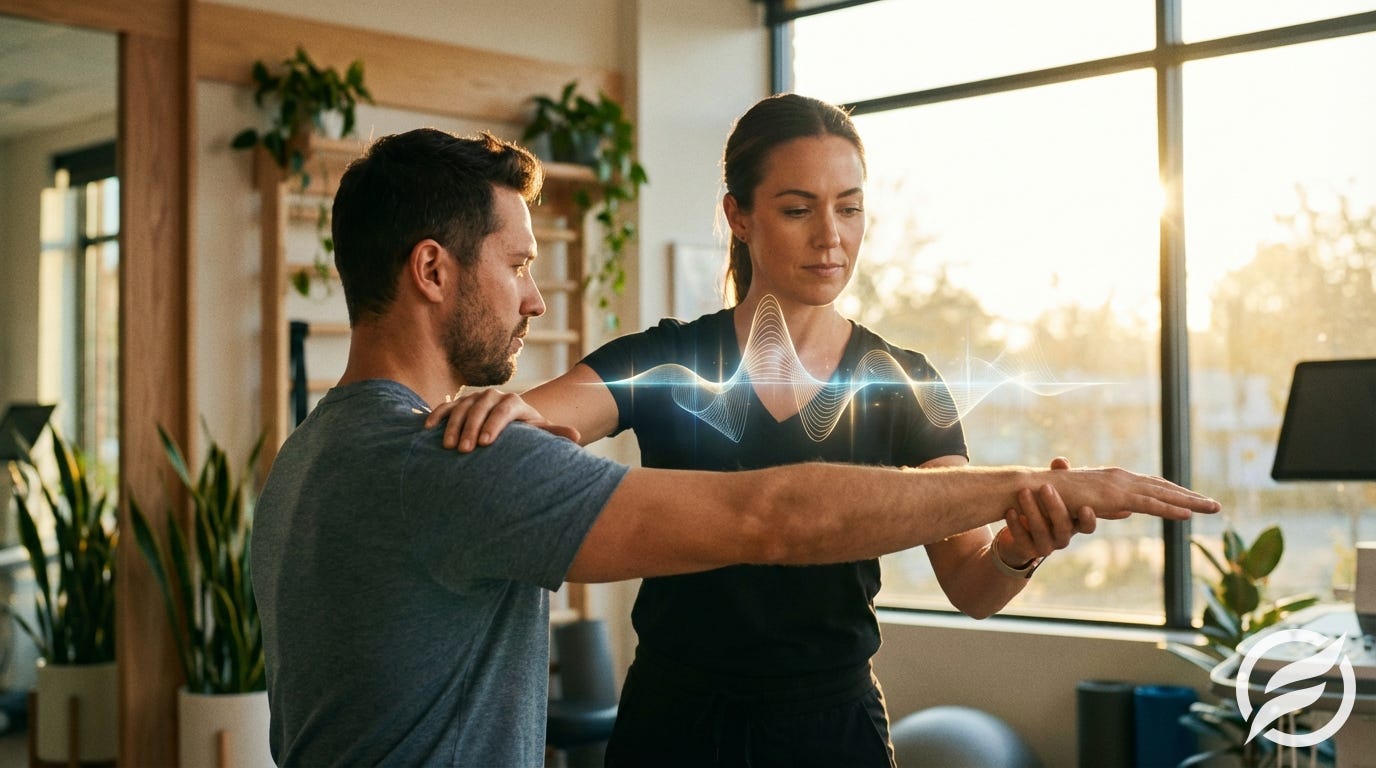
A physician at Penn Medicine recently admitted something that made every PT roll their eyes. Since her clinic adopted an ambient AI scribe, she has to narrate her exam findings out loud for the AI to capture them. "People find that very interesting," she told KFF Health News. One patient said, "I never knew why a doctor would listen there."
PTs read that and thought: welcome to our world. We've been narrating assessments, cueing exercises, and explaining findings out loud since our first clinical rotation. It's not a side effect. It's the job.
The "Side Effect" Nobody Expected
Ambient AI scribes are transforming how physicians conduct patient encounters. The technology listens to the visit, filters out small talk, and organizes the conversation into structured clinical notes. A third of all healthcare providers now have access. Kaiser Permanente has rolled it out to more than 25,000 providers. Epic is launching its own AI scribe widely this year.
The benefits are real. A randomized trial at UW Health, published in the New England Journal of Medicine AI, found that ambient AI scribes reduced documentation time by 30 minutes per day per provider and correlated with meaningful reductions in burnout scores.
But there's a catch nobody anticipated.
Dr. Dina Capalongo, a primary care physician at Penn Internal Medicine, told KFF Health News that she now has to verbalize her physical exam findings during the exam — not after. When she places her stethoscope over the carotid artery, she says out loud that she doesn't hear a bruit. Her patients are learning things about their own bodies they never understood before.
Not everyone sees this as a win. Dr. Genevieve Melton-Meaux, chief health informatics and AI officer at Fairview Health Services, warned that narrating findings during sensitive exams can increase patient anxiety. "Sometimes patients are anxious and scared and my saying things that they don't understand... does not help the situation and honestly is insensitive to what the patient is going through."
Physicians are adapting to a new requirement: thinking out loud. Some love it. Some dread it.
And one entire specialty never had to think twice about it.
PT Was Already There
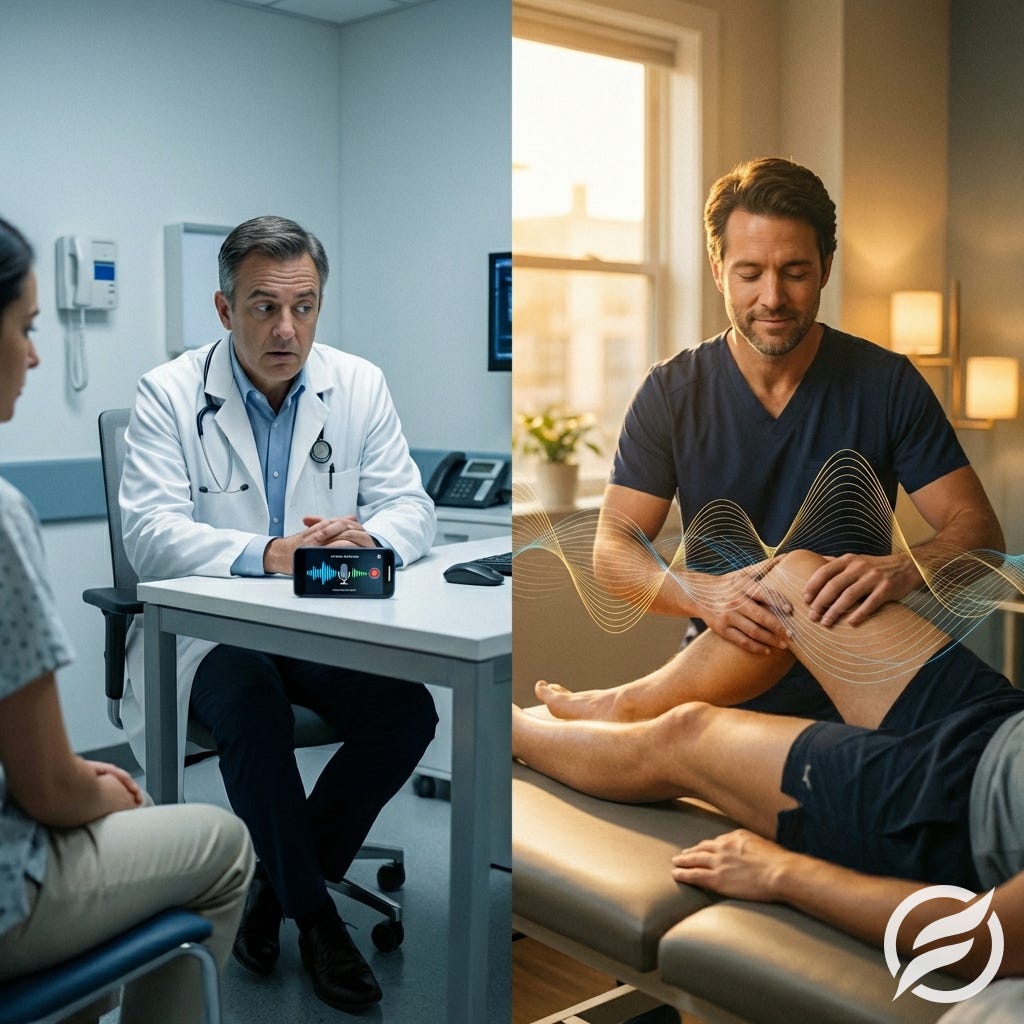
The entire physical therapy session is a narrated conversation. It always has been.
Think about your last patient encounter. You probably said something like:
• "I'm getting 115 degrees of knee flexion today — that's up from 100 last week"
• "Let's try 3 sets of 10 bridges. Squeeze your glutes at the top. Good."
• "I'm going to do some soft tissue mobilization along the IT band. Tell me if the pressure changes."
• "Your shoulder external rotation improved from 30 to 45 degrees this week."
You weren't adapting to new technology. You were treating a patient. The documentation happened to be embedded in the treatment.
Compare that to what physicians are now learning to do:
Physician (new behavior for AI): "No bruit detected over the carotid artery."
PT (same as always): "Your shoulder external rotation improved from 30 to 45 degrees."
Both are clinical findings stated out loud. The difference is that physicians are relearning this skill after decades of silent charting. PTs never stopped.
Patient education isn't a side effect in physical therapy. It's a core competency. Every exercise cue teaches the patient how their body works. Every ROM measurement explained out loud reinforces progress. Every manual therapy narration builds trust.
Ambient AI scribes don't change PT workflow. They simply capture it.
Why Architecture Matters More Than Accuracy
Robert Wachter, chair of the Department of Medicine at UCSF and author of the forthcoming book *A Giant Leap*, raised a concern about AI scribes that deserves attention: "Humans stink at maintaining vigilance over time."
He's right. The human-in-the-loop model — where the doctor reviews and signs off on the AI-generated note — degrades as trust increases. The more accurate the scribe becomes, the less carefully doctors review its output. And AI scribes do hallucinate. Kaiser Permanente calls it "quite rare," but it happens. An AI-generated note might say the doctor planned to refer someone to a neurologist — when the doctor never said that.
In medicine, the AI generates a free-text narrative and the physician skims it. That's where hallucinations hide.
In PT, the AI captures structured data: ROM values, exercise sets, grades, billing codes. These are either right or wrong. There's no ambiguity. A hallucinated "knee flexion 180 degrees" gets caught immediately because you know you measured 115. A fabricated exercise you never prescribed stands out because you remember the session.
The PT workflow doesn't just fit ambient AI better culturally. It fits better architecturally. Structured clinical data is harder to hallucinate convincingly than free-text narrative.
Scribes Are Training Wheels
Wachter said something else that matters: AI scribes are "training wheels" for more consequential AI adoption in healthcare.
He's right about that too.
A scribe captures what happened. An Agent acts on it. The scribe documents your `97110` therapeutic exercise. The Agent checks whether you hit the 8-minute threshold for billing, flags an NCCI conflict with the `97140` you also coded, validates the GP modifier for Medicare, and pre-populates the claim — all before you sign the note.
"It's so much bigger than a scribe," said Jackie Gerhart, Epic's chief medical officer. "It's literally listening and acting in a way that tees things up for me so that I can take action." Epic has roughly 60 AI use cases live for patients, clinicians, and administration, with over 100 more in development.
PT practices that stop at "AI scribe" are celebrating the training wheels. The real value is what happens to the documentation after it's captured. When the note IS the bill, the compliance check, and the care plan — all at once — you've moved from a tool to a digital workforce.
What This Means for Your Clinic
If you're still typing notes after hours, an AI scribe is step one. Here's how to think about it:
Step one: Get an ambient AI scribe built for PT workflow. Not a physician tool adapted for rehab. Look for tools that understand ROM, MMT, special tests, and CPT codes natively. The APTA released formal guidance on AI-enabled ambient scribe technology in September 2025 — read it before your next vendor demo.
Step two: Ask what happens after the note is captured. Does the tool just give you a draft to edit? Or does it check your billing, flag compliance issues, and connect the documentation to the claim? That's the difference between a scribe and an operating system.
Step three: Stop thinking about documentation speed. Start thinking about documentation leverage. The 30 minutes you save on notes is nice. The 5-10% denial reduction from automated billing pre-flight checks is where the real money is.
Doctors are just now learning to say it out loud. You've been doing it your whole career.
The question is: what are you going to do with that head start?