


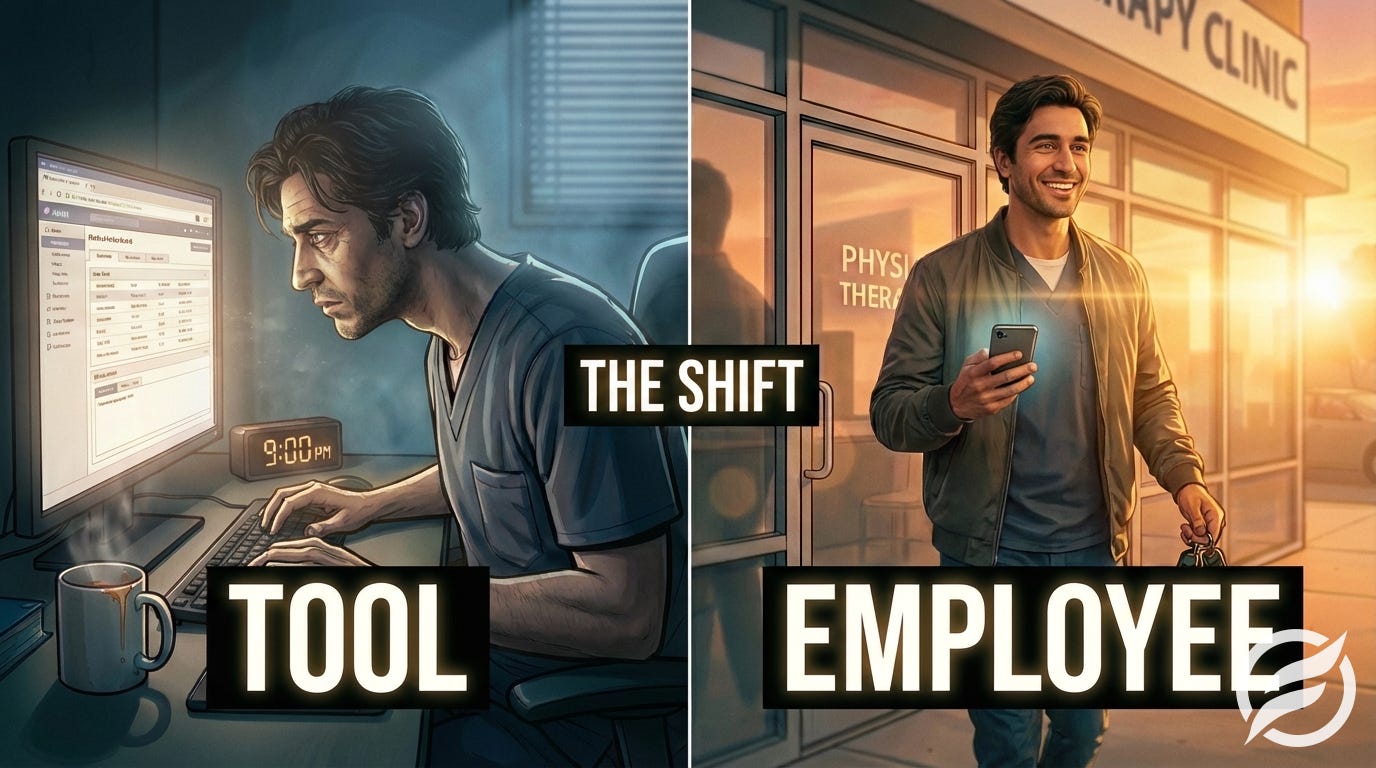
It's 9pm. You're at the kitchen table. The laptop is open.
You bought an AI scribe. You upgraded your EMR. You watched the demos and believed the promises.
And you're still working after your kids went to bed.
Here's the problem: You bought a tool when you needed an employee.
That's not a metaphor. It's the distinction that will shape which clinics thrive over the next few years.
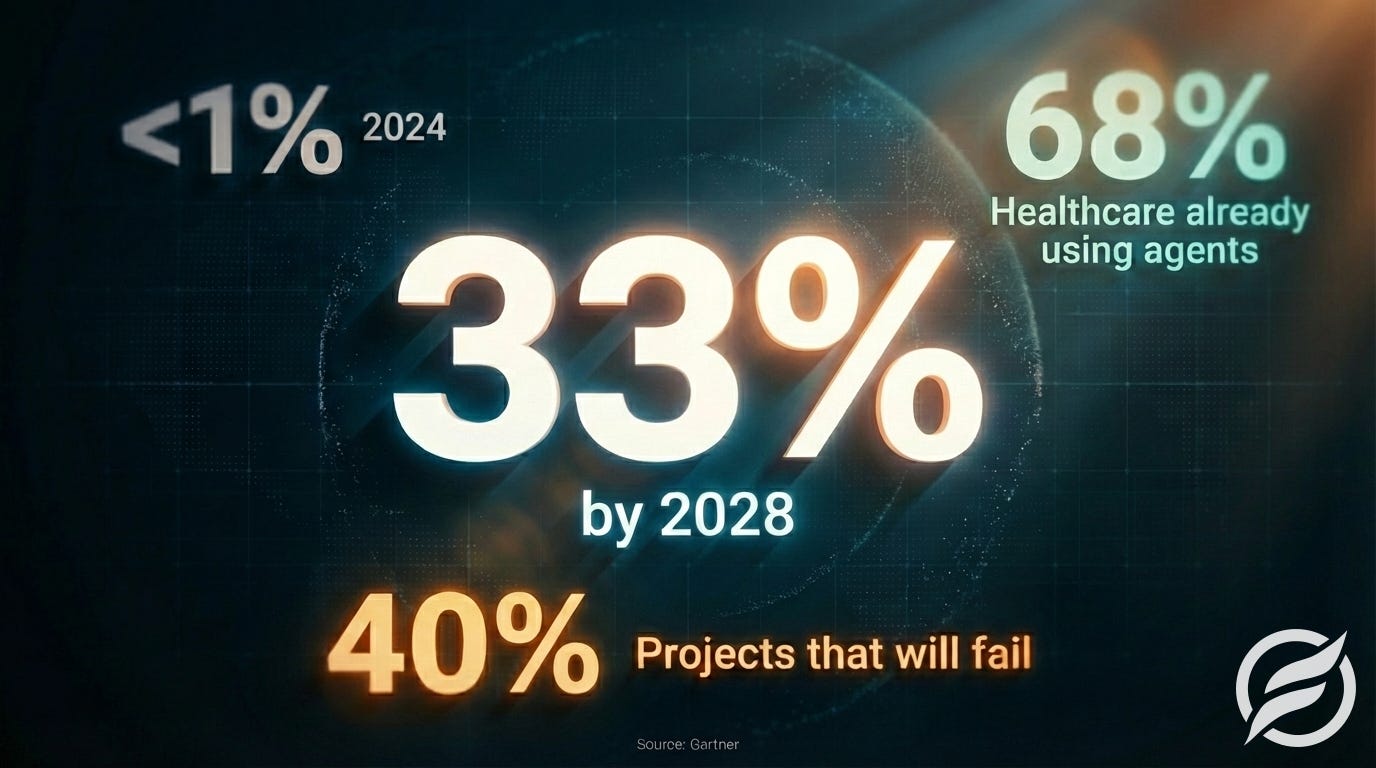
In 2024, less than 1% of enterprise software included agentic AI. By 2028, Gartner projects that number will hit 33%. But for PT clinics, the timeline is more urgent than that.
This is the framework that separates clinics moving forward from those standing still.
The AI You Know Is Not the AI You Need
When most people hear "AI," they think of ChatGPT. Copilot. Those smart autocomplete suggestions in your EMR.
That's generative AI. And here's its fundamental limitation: It waits for you.
Generative AI is reactive. You give it a prompt. It creates content. You give it another prompt. It creates more. You're still the keyboard operator. The AI just helps you type faster.
The problem with faster typing? 72% of PTs use EMRs, but they're still working evenings. Speed wasn't the problem.
The workflow architecture is.
Consider the reality:
• 49.2% of a PT's workday goes to documentation and admin
• 91% of PTs say admin burden contributes to burnout (APTA 2025)
• 57% of practices have dropped payer networks because the admin load isn't worth it
You could type twice as fast and still be working at 9 PM. The bottleneck isn't typing speed. It's the fact that you're typing at all.
Generative AI is like a smart intern at the desk next to yours. You tell them what to do, step by step, and they execute. But you're still doing the thinking. The sequencing. The oversight.
For every single task.
Enter Agentic AI: The Employee, Not the Tool
Agentic AI works differently.
Instead of waiting for your prompt, it pursues goals autonomously. Instead of creating content when asked, it completes workflows without being asked.
The technical version: Agentic AI systems make decisions and take actions with minimal oversight, using a four-step cycle—Perceive, Reason, Act, Learn.
But here's what actually matters:
With generative AI: You say "Generate a SOAP note template." It generates. You review. You edit. You submit.
With agentic AI: The system listens to your patient encounter. Drafts the complete note. Checks for compliance. Flags missing billing elements. Queues it for review. All while you're walking to your next patient.
One requires you to initiate every step. The other completes the workflow and asks for your approval.
That's not a faster tool. That's an employee.
The Tool vs. Employee Test
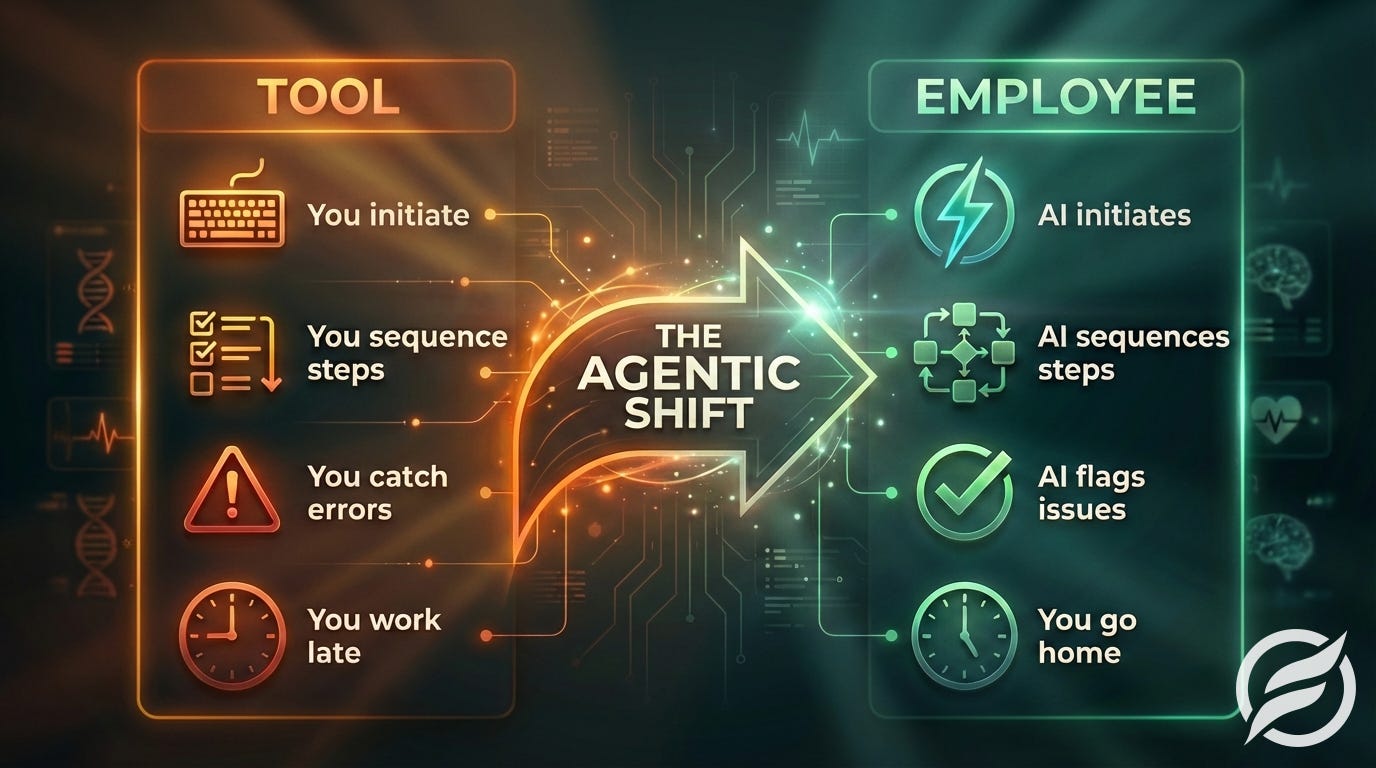
Here's a simple framework to evaluate any AI system:
1. Who initiates the work? You (Tool) vs. The AI (Employee)
2. Who sequences the steps? You (Tool) vs. The AI (Employee)
3. Who catches errors? You, hopefully (Tool) vs. The AI, then you verify (Employee)
4. Who's working at 9pm? You (Tool) vs. Nobody (Employee)
If you're still clicking, copying, pasting, and checking—you have a tool.
If the AI prepares and you approve—you have an employee.
Amanda Saunders at NVIDIA put it well: "Agentic AI builds on generative AI, taking simple responses further with the ability to consider options, go back and redo steps."
The key phrase is "go back and redo steps." Generative AI creates once. Agentic AI iterates until the task is complete.
That's the difference between a chatbot and a colleague.
The Numbers Behind the Shift
The timeline is moving faster than most realize.
• Enterprise software with agentic AI: Under 1% (2024) → 33% projected (2028)
• Work decisions made autonomously: 0% (2024) → 15% projected (2028)
• Healthcare organizations already using AI agents: 68%
That last number is worth sitting with. 68% of healthcare organizations are already using AI agents. Not planning to. Using.
Meanwhile, the pressure on PT keeps building:
• 45-71% of PTs experience burnout (APTA data)
• 33% cite paperwork as their top workplace stressor
• 26,000 PT positions projected unfillable by 2026
• 2% increase in burnout risk for every hour of evening documentation
If you're spending 90 minutes on pajama time every night, that adds up. Five nights a week, fifty weeks a year.
My take: Gartner says 33% of enterprise software will be agentic by 2028. I think PT clinics will hit 60%+ by 2027—because the math demands it.
When Medicare cuts 2.93% and staff keeps leaving, the survival equation changes. The clinics that don't adapt won't gradually fall behind. They'll simply close.
What Agentic AI Actually Does in a PT Clinic

Let me make this tangible. Here's what a Digital Workforce looks like in practice:
Agent 1: Clinical Scribe
Your current workflow:
See patient → Walk to computer → Spend 15 minutes typing → Get interrupted → Finish note at 9 PM.
Agentic workflow:
See patient (ambient AI listening) → Walk to next patient → Get notification: "Note ready for review" → Approve in 45 seconds → Go home at 5:30 PM.
Real results: AtlantiCare rolled out ambient AI to 50 providers. 80% adoption. 42% reduction in documentation time. 66 minutes saved per provider per day.
Agent 2: Revenue Guardian
Your current workflow:
Note completed → Sits in queue → Biller finds issues → Returned for corrections → Resubmitted → Denial arrives weeks later → Appeal begins.
Agentic workflow:
Note completed → Revenue agent runs pre-flight checks (8-minute rule, NCCI edits, missing modifiers, denial risk) → Issues fixed before submission → Clean claim submitted same day.
Real results: Clinics using billing agents report 97% clean claim rates vs. 90% industry average. The Therapy Network (5 clinics) saved $79K in 3 months.
Agent 3: Front Desk Coordinator
Your current workflow:
Phone rings → Answer → Look up patient → Check schedule → Verify insurance (maybe) → Book appointment → Repeat 40 times daily.
Agentic workflow:
Patient texts → Agent checks availability → Verifies insurance → Offers options → Patient confirms → Appointment booked → Reminders scheduled automatically.
Real results: Front desk agents eliminate 3+ hours of phone time daily. Prior auth tracking happens automatically. No-show rates drop with personalized reminders.
The Integration Advantage
Here's what makes agentic AI different from buying three separate tools: The agents talk to each other.
The scribe agent flags a billing issue. The revenue agent catches it and suggests corrections. The front desk agent verifies coverage before the visit happens.
No copy-paste between systems. No "I thought someone else checked that." No 9 PM catch-up sessions reconciling five platforms.
One system. Multiple agents. Shared context.
The 40% Failure Rate (And How to Avoid It)
I'm not going to pretend this is easy.
Gartner predicts over 40% of agentic AI projects will be canceled by end of 2027 due to escalating costs, unclear value, or inadequate controls.
Why they fail:
1. Hype-driven implementation — "Our competitor bought AI, so we need AI." That's FOMO, not strategy.
2. Partial deployment — A scribe agent without a billing agent just moves the bottleneck elsewhere.
3. No human oversight — Autonomy without review creates compliance risk.
4. Integration nightmare — Five AI tools that don't talk to each other means you're still the integration layer.
How to succeed:
1. Start with the pain — Which task do you hate most? Which costs you money in denials? Start there. One agent. One problem.
2. Demand integration — One platform, multiple agents, shared context. If the vendor's scribe doesn't connect to their billing system, walk away.
3. Verify before you trust — Build in a review period. Human-in-the-loop isn't weakness—it's how you catch the 5% where AI gets it wrong.
4. Measure what matters — Time saved. Denials prevented. Staff retention. Evening hours eliminated. If you can't measure it, you can't prove ROI.
Human-in-the-Loop: The Non-Negotiable
Let me address the concern I hear most: "What if the AI makes a mistake?"
Here's the thing: Agentic doesn't mean unsupervised.
The AI does the work. You do the judgment.
Think of it like flying. Autopilot handles altitude, heading, and speed. The pilot monitors, makes decisions, and takes control when needed.
You're not replacing yourself. You're upgrading your role from data entry operator to clinical decision-maker.
The AI prepares the note. You verify clinical accuracy.
The AI flags billing issues. You make the final call.
The AI schedules the patient. You decide if that case fits your clinic.
Human-in-the-loop isn't a compromise. It's the design pattern that makes agentic AI work in healthcare.
Wow, that distinction between a tool and an employee is so sharp! This is truely insightful, moving towards autonomous AI agents, not just faster typing.